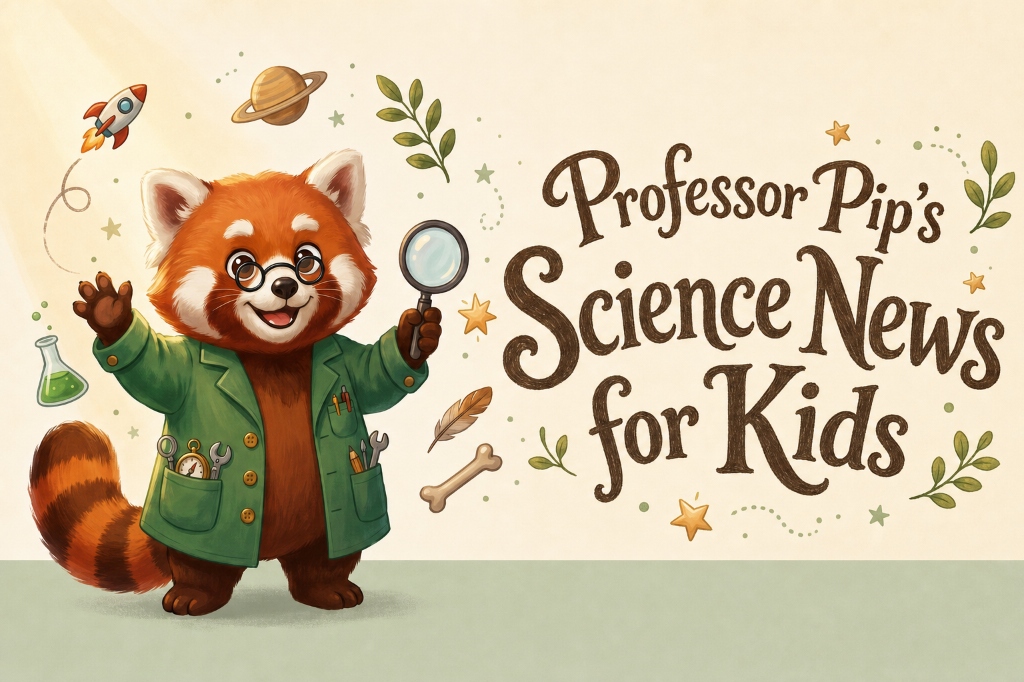
Professor Pip's Science Discovery Banner
Published June 09, 2026

Science for Kids — June 9, 2026: Tiny Brains, Big Skies, City Songbirds

A bee with a brai... • Two planets are s... • City birds are ch...

A bee with a brain smaller than a sesame seed just solved a puzzle

A bee with a brain smaller than a sesame seed just solved a puzzle
The News: Scientists at the Centre for Ecological Research in Hungary just published a study showing that bumblebees can solve brand-new puzzles all on their own — no teaching, no training, just bee brains figuring it out. Their brains are smaller than a sesame seed, but they're problem-solving the way chimpanzees and elephants do.
A Story from Professor Pip's Science Discovery

Professor Pip patted his bulging green lab coat and pulled out — clunk — a small wooden box no bigger than a teacup. A bright yellow string dangled out one side.

"Today, my fellow scientists," he announced, his bushy tail swishing with excitement, "we are going to think like a bumblebee."

Mia tilted her head. "Like a bee?"

"A bee?!" said Leo. "But bees don't think. They just buzz around."

Professor Pip's eyes twinkled behind his crooked spectacles. "Ah! That is what scientists used to believe. But this very week, researchers in a country called Hungary discovered something extraordinary." He set the wooden box on the grass. A fat bumblebee zoomed past Asha's ear and landed gently on a purple wildflower.

"Watch closely." Pip nosed the box toward the children. "Inside this box is a sugar cube. There is no door, no latch, no button. There is only — this." He pointed to the yellow string.

The children stared. Asha reached out and gave the string a tiny tug. Nothing. She pulled harder. Pop! A little lid sprang open. A sugar cube glinted inside.

"YES!" cheered Leo.

"Precisely!" beamed Pip. "Now — what if I told you a bumblebee can do that, with no help, no teaching? She lands. She bumbles. She tries the wrong end. Then — she figures it out. And the next bee who comes along watches her do it… and learns."

"But her brain is sooo tiny!" said Mia.

"Smaller than this sesame seed." Pip held one up between his paw pads. "And yet — she problem-solves. Scientists call this cognition. It means thinking, remembering, and figuring things out. We used to think only big-brained animals — chimpanzees, elephants, dolphins, us — could do it. But maybe being smart isn't about a big brain. Maybe it's about a curious one."

"Oh!" said Leo. "Like how I figured out my new jigsaw without anyone telling me how!"

"Exactly right!" said Professor Pip, his tail swishing wildly. He looked up at a bumblebee bumping clumsily against a blossom, then flying off with golden pollen dusted on her fuzzy legs. "Curiouser and curiouser. The whole garden is thinking, in its own buzzing way." He handed each child a sugar cube. "Now — go find a bee. And just watch."

Spark a Conversation

  • If a bumblebee can solve a puzzle, what other tiny animals might be smarter than we think?
  • When you figured out something hard by yourself, what helped you most — trying, watching someone else, or both?
  • Why might it help a bee to learn from other bees?

Two planets are sharing a "cosmic kiss" — and you can see it tonight

Two planets are sharing a "cosmic kiss" — and you can see it tonight
The News: Right now, on Monday and Tuesday nights, two of the brightest dots in our sky — Venus and Jupiter — appear so close together they look like one giant glowing pair. Astronomers call this a conjunction , but they like to nickname it a "cosmic kiss."
A Story from Professor Pip's Science Discovery

The sun had just slipped behind the hill, leaving the sky in glowing layers of peach, lavender, and deep navy. Professor Pip stood at the top of the hill, fishing inside his green lab coat. Out came his small brass telescope, with a satisfying click-click as he opened it.

"Up there!" he whispered, his paw trembling with excitement. "Look, look, look — there they are!"

Mia and Theo squinted at the deepening sky. Two bright dots glowed close together, just above the silhouettes of pine trees.

"They're so close together!" gasped Mia.

"Are they about to crash?!" said Theo, alarmed.

Professor Pip burst into a delighted little laugh. "Oh my whiskers, no! That, my fellow scientists, is the secret. They look close. But they are very, very far apart. The bright one with the warm glow — that's Jupiter, the biggest planet in our whole solar system. The dazzling silvery one — that's Venus, our closest planet-neighbor."

"But they look like they're touching!" said Mia.

"Watch this." Professor Pip held one paw close to his face and stretched the other out at arm's length. "From my eye, my pinky toe and my faraway paw look like they're lined up. But are they actually touching?"

"No!" the children chorused.

"Exactly right! That is called perspective. When two things line up from where you're standing, they look right next to each other — even if one is much, much farther away than the other. Right now, Venus is about 67 million miles from us. Jupiter is more than 460 million miles away. They're not kissing. They're just lined up from our little spot on Earth."

"Like…" Theo squinted, holding his thumb up in front of his eye. "Like when I cover the whole house with my thumb!"

"Precisely!" Pip nearly tumbled with delight. "Astronomers call this special lineup a conjunction. The planets orbit the sun at different speeds — Venus zooms around fast, Jupiter strolls around slowly. Every few months, from our view, they meet up like old friends bumping into each other on a street."

Pip held up the telescope. Mia peeked through. Jupiter wasn't just a dot — it had stripes! And four tiny dots floated beside it. "Those are Jupiter's moons!" Pip whispered. "Galileo saw them with a telescope just like this one, more than 400 years ago."

A cool breeze rolled across the hilltop. Pip looked up at the two shining planets, his fluffy ears outlined in fading light. "Tonight after dinner — go outside. Find the brightest two stars in the western sky. Those are them. The kiss won't last long. The orbits keep moving."

Spark a Conversation

  • Why do you think Venus moves faster around the sun than Jupiter does?
  • Can you think of other things that look close together but aren't really? (Hint: try holding your thumb up at arm's length and "blocking" a tall tree.)
  • If you could fly between the two planets, what would the view look like halfway there?

City birds are changing their songs to be heard over traffic

City birds are changing their songs to be heard over traffic
The News: A new study from the same Hungarian research center found that birds living in busy cities are singing differently than birds living in quiet forests. They sing higher, faster, and louder — all so their voices can rise above the roar of cars, buses, and air conditioners.
A Story from Professor Pip's Science Discovery

Professor Pip's porch had a perfect view of the busy street below. A truck rumbled past. A bus hissed. A jackhammer thudded somewhere a block over. And on the porch railing — improbably — a small red-breasted robin sat with her beak open, singing her tiny heart out.

"Can you hear her?" Pip whispered, leaning forward.

Sofia, Leo, and Jun cupped their hands behind their ears. Sure enough — through all the city noise — a clear, sparkling tweet-tweet-twee-eet! rose above the rumble.

"How does she do that?" asked Leo. "It's so loud out here!"

"Ah!" Professor Pip patted his pockets and produced a small brass tuning fork. He gave it a sharp tap on the porch railing. PINGGGG! A high, silvery ring filled the air. He held it close to Sofia's ear. Then he picked up a small wooden drum and gave it a thump. BOOM! A low rumble.

"Listen carefully," he said. He tapped the tuning fork again — PINGGGG! — and at the same time thumped the drum — BOOM!

"I can still hear the ringing!" said Jun, surprised.

"Exactly!" Pip's tail swished triumphantly. "Sound travels in waves — like ripples in a pond. Some waves are tall and slow — those make low sounds, like a truck rumbling or thunder. Some waves are short and fast — those make high sounds, like a bird's tweet or a whistle. The science word for how fast those waves wiggle is frequency."

"Higher sounds have more wiggles per second," Pip went on, pulling out his pocket notebook and sketching little squiggly lines. "And here's the cool part — high frequencies cut right through low rumbles. They don't get buried."

"That's why the robin sounds so sharp!" cried Sofia.

"Precisely!" said Pip. "And here is what those scientists in Hungary just discovered. They listened to thousands of birds — some in forests, some in cities. They found that city birds sing higher, louder, and faster than country birds. The cities are full of low rumbles — traffic, machines, big crowds. So the birds have shifted their songs up, up, up, where the rumbles can't reach. They're adapting."

Jun's eyes widened. "Oh! Like when Mom whistles for me at the playground — I can hear her over all the kids yelling!"

"Exactly right!" Pip laughed. "Your mother is using the very same trick this clever robin has worked out. A whistle sails right over the noise."

The little robin sang again. Pip looked at her with quiet wonder, his crooked spectacles slipping further down his nose. "Every creature in this city is figuring out how to be heard. Even the smallest among us."

He handed each child a tuning fork. "Now — try it in a noisy room. See if a friend can still hear it. Then try it outside, where it's quiet. Listen to the difference."

Spark a Conversation

  • Why might it be a problem for birds if they have to sing louder all the time?
  • What's the loudest, lowest sound in your neighborhood? What's the highest?
  • Could humans "adapt" the way these birds have, to live in noisier places?

Curiouser and curiouser. See you Thursday, my fellow scientists. — Professor Pip 🥼 & the Daily Science for Kids team.

Back to Professor Pip's Science Discovery Feed